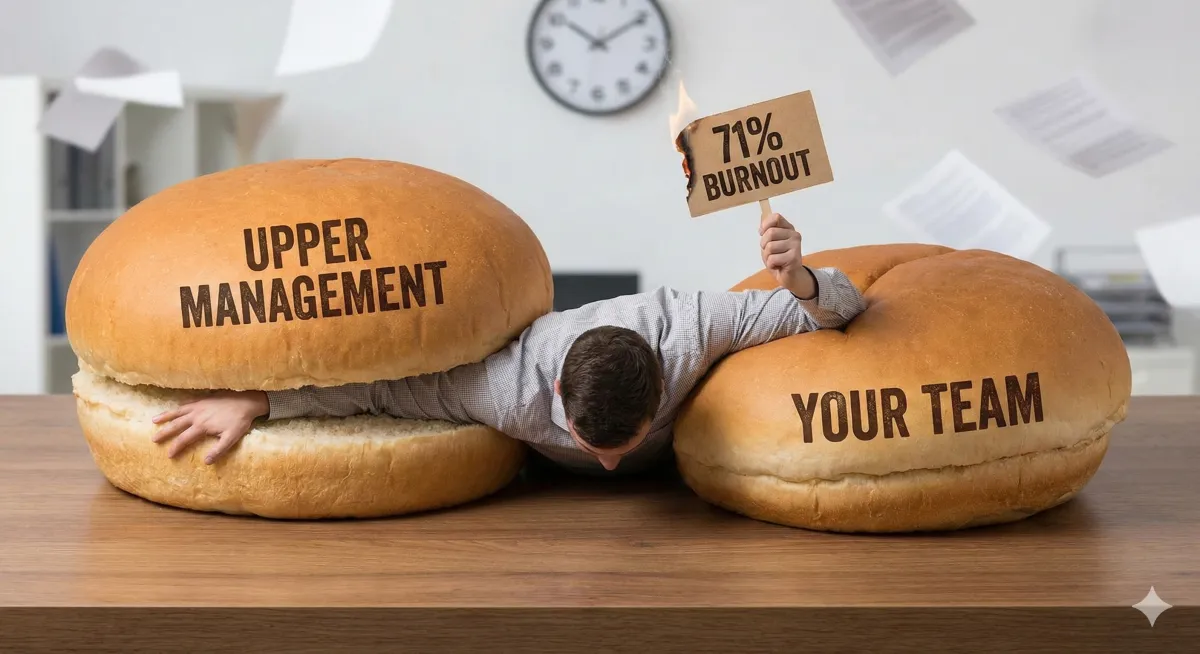
The Sandwich Manager (And Why 71% of You Are Burning Out)
The Sandwich Manager (And Why 71% of You Are Burning Out)
Let me ask you a question.
How many sandwiches do you think a sandwich maker can make in an hour?
Go on, have a guess. 20? 30? Maybe 40 if they're really quick?
At Greggs, sandwich makers had targets of over 50 sandwiches an hour.
Now, before you think I've lost the plot talking about sandwiches... stick with me.
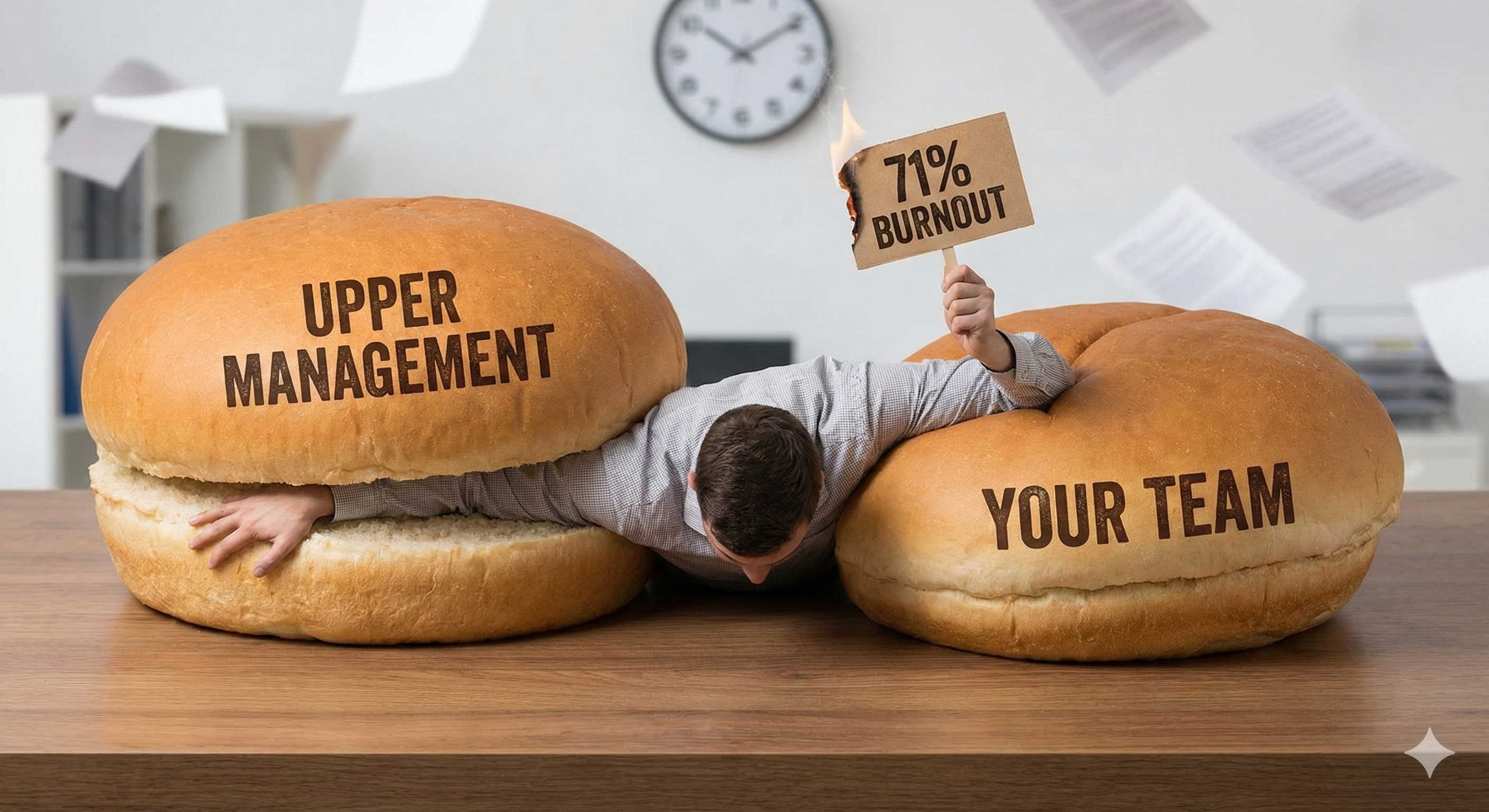
Because what I learned watching people try to hit those numbers taught me everything I need to know about why middle managers burn out - and what you can actually do about it.
The 50-Sandwich Reality
For some people, 50 sandwiches an hour was absolutely fine. They'd get into a rhythm. High-volume shop, same sandwich over and over. 50, 55, sometimes 60 an hour. No problem.
But for others? Really hard.
Small shop, small team, constant interruptions. Hitting 50 felt impossible.
But here's what I noticed.
If you had at least one person in that shop who could do 50 an hour... everyone else got there much faster.
Because it made it possible. People could see it wasn't just some unrealistic number plucked out of thin air.
It's like the four-minute mile. Before Roger Bannister broke it, everyone said it was impossible. Then he did it. And shortly after, loads of people ran under four minutes.
It wasn't that they suddenly got faster.
It's that they believed it was possible.
Performance doesn't rise when pressure increases. It rises when belief crosses a visible threshold.
The Shoplifting Moment (And Why Futility Kills Motivation)
I was in a shop one day near Elephant and Castle. Chatting to the sandwich maker.
This guy walks in with a supermarket shopping basket. Walks straight to the sandwich display. Fills it. Sandwiches piled high.
Then just... walks out.
Broad daylight. Didn't flinch.
The face of that sandwich maker. I still remember it.
She'd been there since five in the morning. Working hard. Trying to hit her numbers.
And now she's got to remake all the sandwiches that were just stolen.
And it might happen again tomorrow.
I had to tell her: Don't challenge. Your safety matters more than sandwiches.
But how do you keep that person motivated? How do you help them not take it personally?
It wasn't just about the sandwiches being stolen.
It was about the repetition of futility.
Make sandwiches. They get stolen. Remake them. Belief drops. Motivation drops. Energy drains.
When effort is repeatedly undone, belief drains faster than energy.
And that sandwich maker?
She's every middle manager right now.
You're Caught in the Same Loop
You work hard to hit the numbers. Strategy set by someone else at board level.
You watch it fall apart. Restructures. Pivots. Resources pulled. Team members leave.
You're told, "Just keep going. Make it work."
And tomorrow, you do it all again.
71% of middle managers report burnout. Higher than any other group in the organisation.
So if you're thinking, "I must be the only one who can't handle this"...
You're not.
Here's why it's hitting you so hard.
You're caught between what head office wants and what's actually happening on the ground.
You're told to be committed to strategies you didn't create and might not even agree with.
You're expected to fill gaps - ability gaps, staffing gaps, knowledge gaps - without being given the tools to do it.
And you're supposed to "keep things running smoothly."
Which means you absorb all the stress.
What Middle Managers Can Actually Control When Strategy Is Set Above
You might not be able to control the strategy. The "what" might be fixed.
But you can control the how.
How you introduce it. How do you get your teams to buy into it? How you make it work on the ground.
I remember driving back from a meeting with my boss once.
Head office had brought in a new policy. We needed the managers to implement it.
She said, "They've gone away motivated. Excited even. How did you do that?"
Simple.
I let them take control of the how.
In the meeting, we discussed what they wanted. How they'd get their teams bought in. How they'd do it.
They agreed it amongst themselves.
And off they went. Did a brilliant job.
When you give your team autonomy over the how, they commit.
When you dictate the how, they resist.
The Smooth Trap (And Why Middle Managers Fall Into It)
There's a temptation when you're sandwiched in the middle. I call it The Smooth Trap.
You fill the gaps yourself. You step in. You cover when you're short-staffed.
Because you don't want to look incompetent to your boss.
And you don't want to be seen as unsupportive to your team.
So you absorb all the stress to keep things running smoothly.
I used to have to tell area managers to go and run shops when we were short-staffed.
I knew it was wrong long-term. It undermined them.
But short-term? Convenient for the business.
And the less experienced ones crumbled easily.
Here's what actually works instead.
Learn to Manage Up
Go in with solutions, not just problems.
Frame it as tweaking, not rewriting.
Keep your boss informed so they're not caught off guard.
Most managers don't like surprises. They tend to be shocks rather than pleasant ones.
What to Do This Week
Think about where you're stuck.
Is it belief?
Are you trying to implement something you don't actually believe will work?
Manage your state first. Look at the positives. Get your mind in the right place before you communicate it to your team.
Is it control?
Are you dictating the how instead of letting your team design it?
In your next meeting, present the what and the why. Then ask: "How do you think we should make this work?"
And listen.
Is it the Smooth Trap?
Are you absorbing all the stress, filling every gap, trying to keep everything perfect?
Start managing up. Go in with solutions. Keep your boss informed. Stop absorbing what the system should be fixing.
You're not alone in this.
71% of middle managers report burnout.
But you don't have to stay stuck.
The Bottom Line
If you're feeling squeezed between what's expected from above and what's possible below, you're not failing.
You're caught in a system that hasn't given you the tools to navigate it.
If you're a middle manager who feels stuck, join The Empowered Leader's Circle.
Free community. Real support. Practical tools from people who've been exactly where you are.
This is what I now call The Accountability Paradox: being held responsible for outcomes you don't fully control.
If this pattern feels familiar, the free guide explains the shift that breaks it → Get the Free Guide
Jon Manning
Former Retail Operations Manager | Author of Emotional Intelligence Unleashed (I made every mistake first)
Frequently Asked Questions
Why do middle managers burn out more than other roles?
Middle managers are sandwiched between strategy from above and reality below, expected to implement decisions they didn't make while absorbing all the stress to "keep things running smoothly" - without the tools or authority to fix systemic problems. Research shows 71% report burnout, higher than any other organisational level.
How can managers get team buy-in on strategies they disagree with?
You can't fake belief - your team will see it immediately. The key is managing your own state first (focus on what IS possible within the strategy), then giving your team control over the "how" even when you can't control the "what." Autonomy over implementation creates commitment even when the strategy wasn't their choice.
What is The Smooth Trap for managers?
The Smooth Trap is when managers fill every gap, step in constantly, and absorb all stress to avoid looking incompetent to their boss or unsupportive to their team. It creates burnout while hiding systemic problems that actually need to be escalated. The trap feels responsible in the short term but is unsustainable in the long term.
What does "managing up" actually mean for middle managers?
Managing up means keeping your boss informed with solutions (not just problems), framing necessary changes as tweaks rather than rewrites, and preventing surprises. It's about protecting yourself from absorbing stress that should be escalated while maintaining your boss's confidence in your judgment.
How do you maintain belief when implementing strategies you disagree with?
Focus on what IS achievable within the strategy rather than what's wrong with it. Manage your emotional state first - if you communicate doubt, your team amplifies it. Then give your team control over "how" it is implemented. When people design the execution themselves, they commit to making it work even if they didn't choose the direction.
Why does autonomy matter more than control in management?
When you dictate exactly how something should be done, people resist because they have no ownership. When you define the outcome (the "what") and let your team design the process (the "how"), they commit because it becomes their solution. Autonomy over execution creates accountability that control never can.
What are the warning signs of The Smooth Trap?
You're constantly stepping in to cover gaps, you're working longer hours than your team, you avoid telling your boss about problems because you "should be able to handle it," and you feel like if you stop absorbing stress, everything will fall apart. The trap makes you feel indispensable while actually making you replaceable through burnout.